.jpg)
Eminent free market economist Arvind Panagariya has been appointed to run Indian Prime Minister Narendra Modi's new Policy Commission, set up to modernise economic strategy after decades of Soviet-style central planning.
'You can fight to win leadership of a party, yet join party rivals to win a general election in the US. The fact that dissent is not rebellion is not really appreciated in India, where we are used to the 'High Command' culture,' says T V R Shenoy.
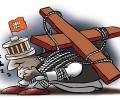
'Poor home work, and a subsequent loss of nerve.' 'This sums up the Modi government's current travails, the stall in key sectors, fading momentum, irritability,' points out Shekhar Gupta.

General Bajwa, who commanded the 10 Corps that looks after Pakistan's border with India, is unlikely to change his army's and nation's policy on Kashmir,' says Ambassador M K Bhadrakumar.

'She preserved national unity against great odds.'
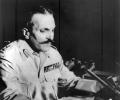
29 years ago this August, Pakistan's dictator, the general who made jihad part of Pakistani State policy, died in a mysterious air crash. Did the KGB, the then USSR's dreaded espionage agency, assassinate Zia-ul Haq? Was India's RA&W responsible for blowing Zia's military aircraft out of the skies? Was it Zia's many enemies in Pakistan's military? Was it a box of mangoes as Mohammad Hanif speculated in his fascinating novel about Zia's death? Or was the assassin someone else?
29 years ago this August, Pakistan's dictator, the general who made jihad part of Pakistani State policy, died in a mysterious air crash. Did the KGB, the then USSR's dreaded espionage agency, assassinate Zia-ul Haq? Was India's RA&W responsible for blowing Zia's military aircraft out of the skies? Was it Zia's many enemies in Pakistan's military? Was it a box of mangoes as Mohammad Hanif speculated in his fascinating novel about Zia's death? Or was the assassin someone else?
29 years ago this August, Pakistan's dictator, the general who made jihad part of Pakistani State policy, died in a mysterious air crash. Did the KGB, the then USSR's dreaded espionage agency, assassinate Zia-ul Haq? Was India's RA&W responsible for blowing Zia's military aircraft out of the skies? Was it Zia's many enemies in Pakistan's military? Was it a box of mangoes as Mohammad Hanif speculated in his fascinating novel about Zia's death? Or was the assassin someone else?

Aziz Haniffa, who has covered every Indian Prime Minister's visit to the US since Rajiv Gandhi in 1985, gives us a peek into what's happening in Washington, DC on the eve of the Modi-Trump summit.

With the images of Rajendra Babu, Radhakrishnan, K R Narayanan, V V Giri and Kalam in my mind, the image of my beloved hero dancing ungainly to 'Merey angney main tumharra kya kaam hai', doesn't make a smooth transition, says Sudhir Bisht.

'When war is thrust on you as in 1962 and 1965 or is tempting as in 1971, ensure that all other fronts are kept quiet, leaving your army free to deal with one,' says Shekhar Gupta.
A summary of the day's matches in the Syed Mushtaq Ali Trophy T20 tournament.
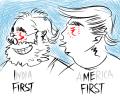
'Even in this age of self-willed and authoritarian leaders and spontaneous gestures, a script is still written,' notes Ambassador B S Prakash, imagining the 'talking points' are for the India-US summit on June 26.

20 years ago this day, May 11, 1998, India conducted its second nuclear test at Pokharan in Rajasthan. In a fascinating interview on Rediff.com, K Subrahmanyam revealed how Indian PMs reacted to nuclear ambitions.
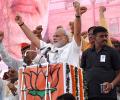
'There appears to be in the Indian polity a link between being Single and being of prime ministerial timber. It is a trend, a preponderance -- not a statistical verity,' says Dr Shashi K Pande.

Why has a nation created on strong secular principles slowly chipped away those essential values? Why are so many Indians willing to compromise their freedoms and those of their compatriots for the cause of economic progress and to see a shining India,' asks Aseem Chhabra.


Friends and colleagues pay rich tributes to the "charming, approachable, and very accessible" Indian Constitution scholar Granville 'Red' Austin.
